

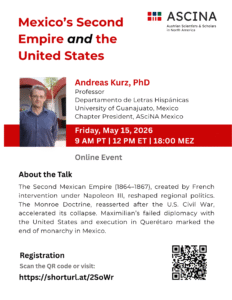
 The Second Mexican Empire (1864–1867) under Maximilian of Habsburg is often underestimated in historiography. Orchestrated by Napoleon III, the French intervention had major geopolitical consequences and reflected Europe’s fraught relationship with its former colonies. Colonial dynamics—still visible today, particularly in U.S.–Latin American relations—shaped Mexico’s development with lasting effects. After the U.S. Civil War, the Monroe Doctrine accelerated the empire’s collapse, while Maximilian’s attempts at rapprochement with the United States proved futile. His execution in Querétaro symbolically marked the end of monarchical legitimacy in the region.

Andreas Kurz (Zwettl, 1968) studied Comparative Literature and Romance Studies in Vienna and Puebla (Mexico). He lives and works in Mexico since 1999. Since 2006, he is a professor at the Universidad de Guanajuato, where he founded the Master’s program in Latin American Literature, which he headed for six years. From 2016 to 2024, he was the head of the department. He has published books on Mexican Modernismo, the Cuban novelist Alejo Carpentier, questions of mimesis, and various topics in 19th-century Mexican literature. In 2013, his novel La joroba was published in Venezuela. Also in 2013, the volume El general Riva Palacio y la vajilla de Francisco José, which deals with some peripheral aspects of the Second Mexican Empire, was published in Querétaro. In 2017, he published the essay Viena: una ficción. In 2023, his book The French Intervention and the Second Mexican Empire appeared in Berlin. Andreas Kurz is a contributor to the cultural supplements of several Mexican daily newspapers and magazines. He is a level II member of the Sistema Nacional de Investigadores (SNI). He has published over 100 articles in academic journals and other media.


