


Modern medicine generates vast and complex data sets, ranging from medical images to genetic measurements. A central challenge is to compare such data in a meaningful way in order to identify patterns, group similar samples, and better understand disease. Classical machine learning methods often struggle when data is high-dimensional, noisy, or lacks a simple geometric structure.
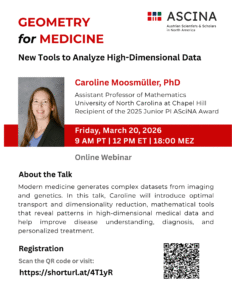 Speaker Caroline Moosmüller is an Assistant Professor in the Department of Mathematics at the University of North Carolina at Chapel Hill, where she leads the Geometric Data Analysis research group.
More info and sign up: https://ascina.at/geometry-for-medicine-new-tools-to-analyze-high-dimensional-data/


