

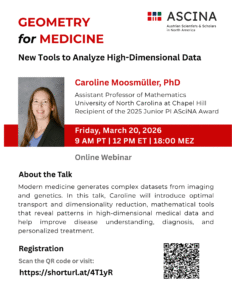
 Modern medicine generates vast and complex data sets, ranging from medical images to genetic measurements. A central challenge is to compare such data in a meaningful way in order to identify patterns, group similar samples, and better understand disease. Classical machine learning methods often struggle when data is high-dimensional, noisy, or lacks a simple geometric structure.
In this talk, I will introduce optimal transport as a powerful mathematical framework for comparing data sets by viewing them as distributions rather than individual data points. Combined with dimensionality reduction, this approach allows us to simplify data while preserving the most important differences between samples. I will illustrate how these ideas can be applied to medical data, with a focus on gene expression measurements in cancer research, where they help distinguish disease types and reveal underlying biological structure.

Caroline Moosmüller is an Assistant Professor in the Department of Mathematics at the University of North Carolina at Chapel Hill, where she leads the Geometric Data Analysis research group. She previously held positions as a Visiting Assistant Professor at the University of California, San Diego, and as a postdoctoral researcher at Johns Hopkins University. She earned her PhD in 2017 from Graz University of Technology.
Her research focuses on the development and theoretical analysis of numerical methods for processing and interpreting high-dimensional data, with particular emphasis on applications in biology and medicine.
Caroline Moosmüller has received multiple awards for her scientific work, including two grants from the National Science Foundation (NSF), a Junior Faculty Development Award, a Seed Grant from the University of North Carolina, an Entrepreneurial Award, travel support from the Simons Foundation, and most recently, the 2025 ASciNA Junior Principal Investigator award.


